English Classes 5H/sob 2025-26
Gesellschaftliche Bildung - Nachhaltigkeit - SUSTAINABILITY
Check out the following links:
The Kids Are Alright in Australia, No Thanks to the Social Media Ban (cato.org)
Australia says it can’t go it alone on social media ban for kid (politico.eu)
Are social media bans the best solution? (The European Commission)
Are social media bans the best solution? (The Christian Science Monitor)
Did Australia's under 16-social ban work? (BBC Video)
Is Australia's social media ban for kids working? (YouTube)
How Australias' pioneering social media ban is impacting teens (YouTube)
Information Labs: Social media Ban Repository (various opinions and statistics)
January - February 2026: The Reader
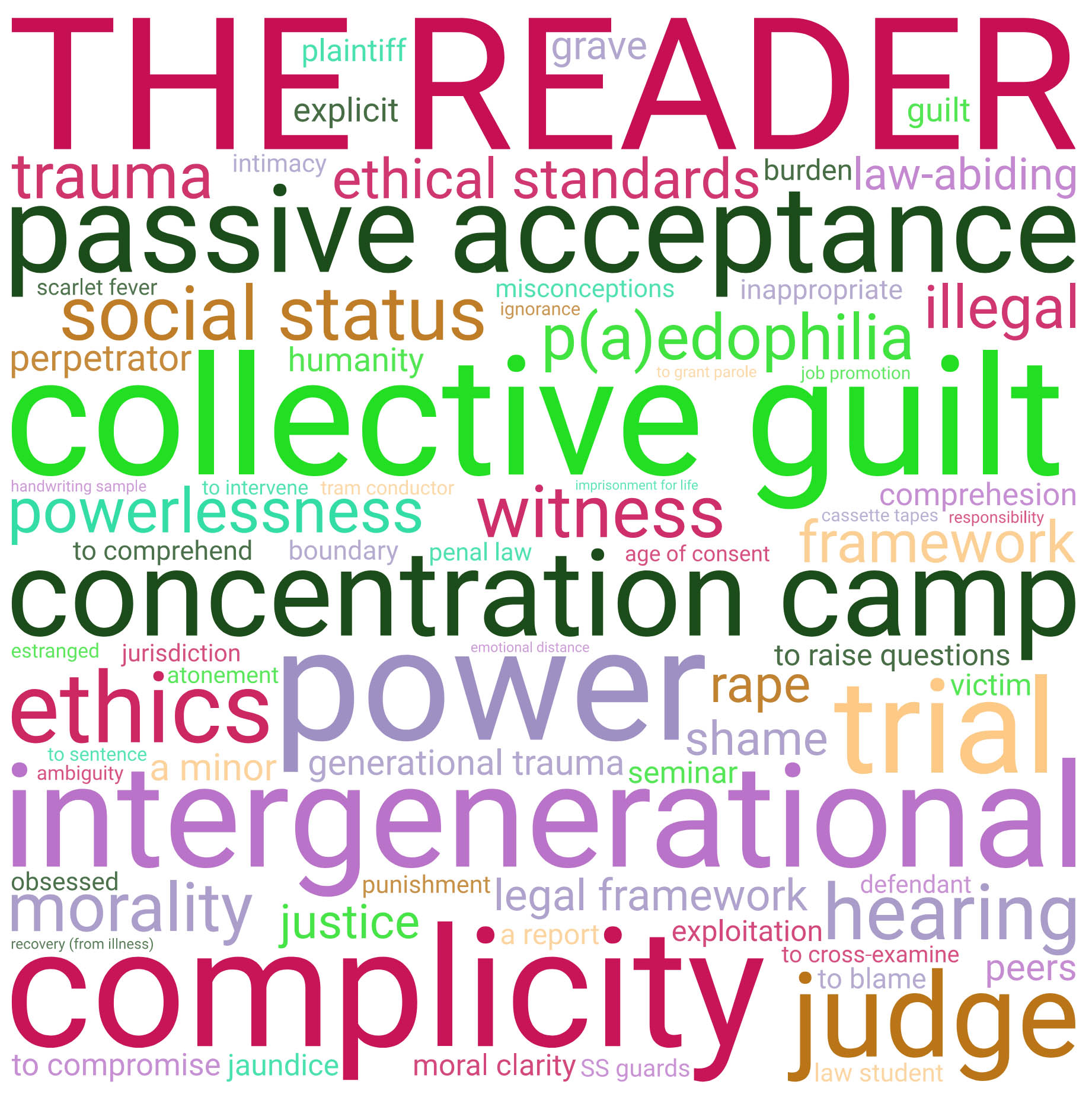
January 2026
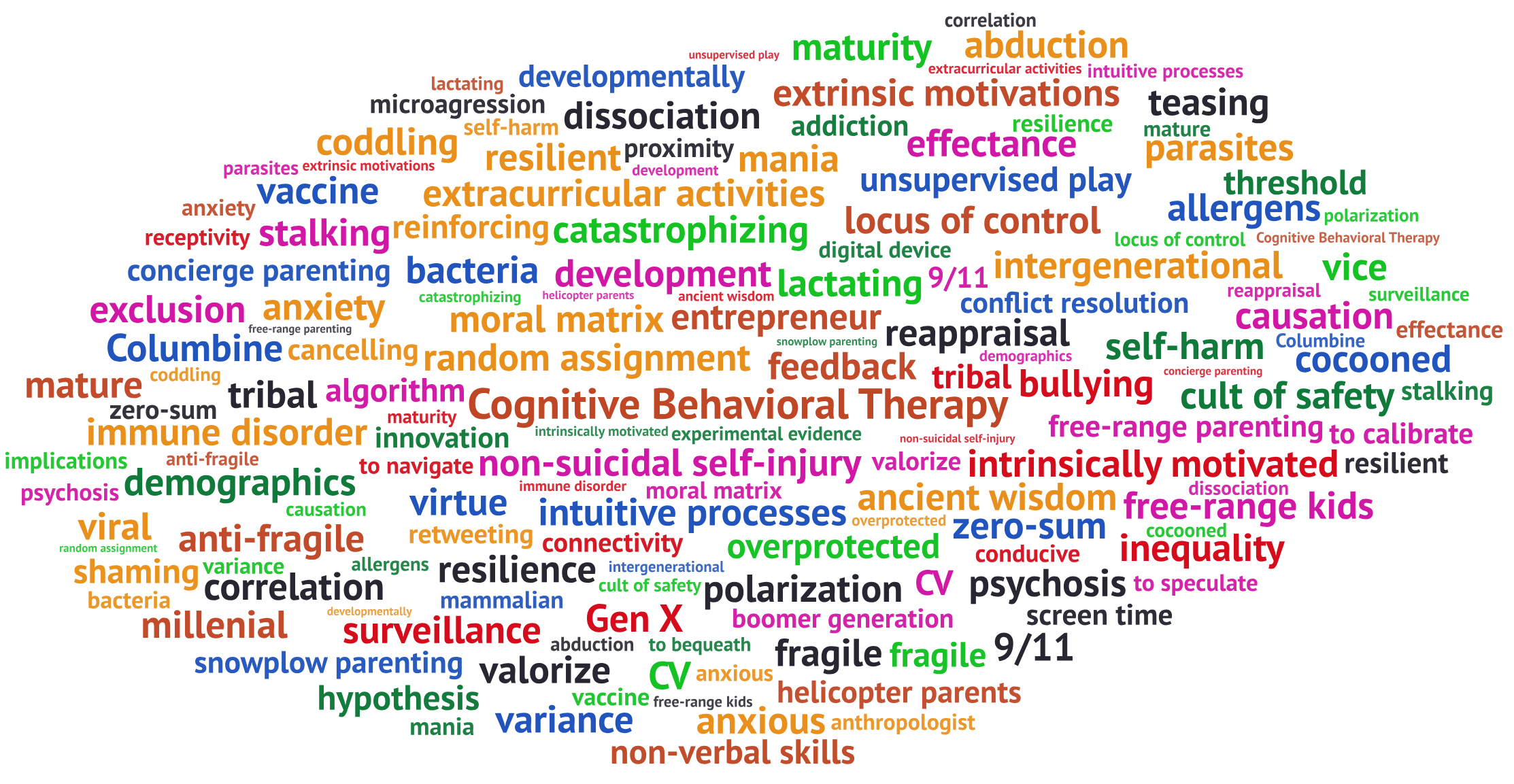
Jonathan Haidt has come up with new evidence: Check out this interview
AGAIN: YouTube Podcast: Jonathan Haidt on gen Z fragility, social media, and the cult of saftey.
Listen to the podcast and answer these comprehension questions (pdf)
Location Guide: Where the answers to these 25 questions can be found in the podcast (pdf)
Australia Social Media Ban Word Cloud:
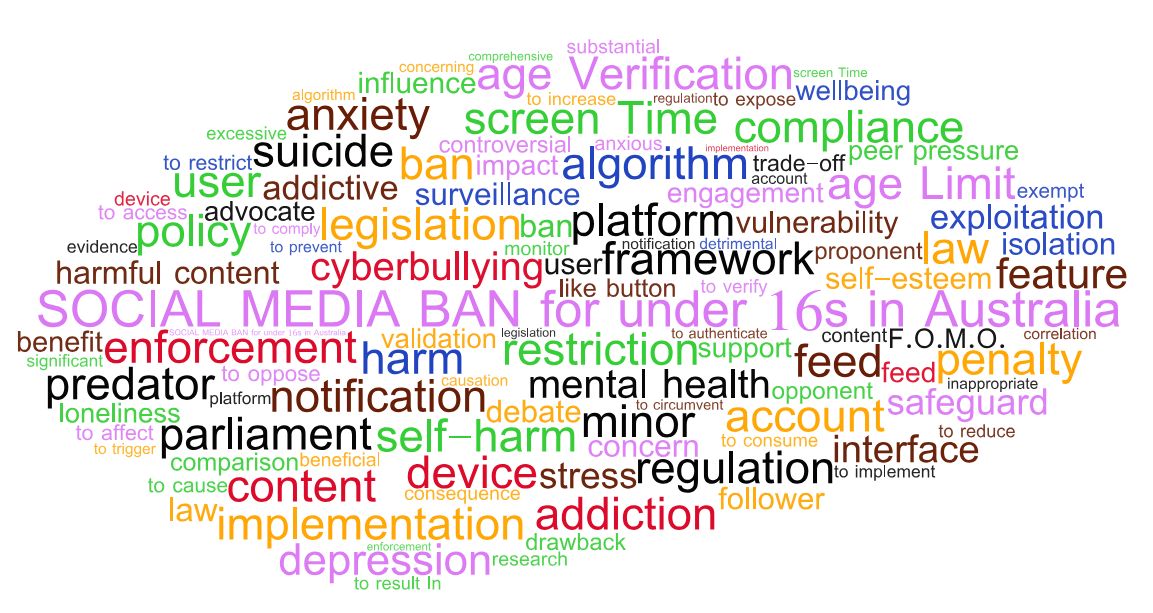
8 January 2026
YouTube Podcast: Jonathan Haidt on gen Z fragility, social media, and the cult of saftey.
Transcript of the J. Haidt podcast
Try this quiz about the Haidt podcast
There will be an extensive test about this topic, in the form of an argumentative or expository essay, and a vocabulary test.
15 December 2025
AU Social Media Ban: List of Arguments - VOCABULARY WORK (pdf)
11 December 2025
Written exercise:
Make It More Erudite
1. Kids spend too much time on their phones and it's bad for their sleep. (excessive, adolescents, screen time, adversely, affect)
2. Social media companies want people to use their apps as much as possible so they can make more money. (platforms, maximize, engagement, revenue, incentivized)
3. When kids see other people's perfect lives online, they feel bad about themselves. (exposure, curated, content, self-esteem, negative impact)
4. The apps are made to keep sending you things so you keep looking at your phone. (notifications, algorithms, designed, sustain, attention)
5. Parents worry that their children are on social media all the time instead of doing other things. (concerns, preoccupied, platforms, neglecting, activities)
6. Checking your phone a lot can make it hard to focus on schoolwork. (frequent, compulsive, impair, concentration, academic performance)
7. Some people say that being online too much makes young people feel alone even when they're with friends. (excessive, digital consumption, paradoxically, isolation, physical presence)
8. The apps use tricks to make you want to keep using them. (employ, psychological techniques, encourage, sustained, usage)
9. Teenagers often compare themselves to what they see online and feel like they're not good enough. (engage, social comparison, idealized, inadequate, portrayals)
10. Looking at screens before bed stops your brain from getting ready to sleep. (exposure, blue light, inhibits, production, melatonin)
11. Kids get stressed out when they see how many likes and comments other people get. (anxiety, metrics, social validation, peer engagement, generate)
12. The problem is that these apps are really good at making people want to use them more. (issue, platforms, effective, compelling, continued engagement)
13. Young people feel like they have to check their phones all the time or they'll miss something important. (compulsion, fear of missing out, FOMO, perpetual, connectivity)
14. Using phones too much can make people bad at talking to others face-to-face. (excessive, usage, diminish, interpersonal, communication skills)
15. Some experts think that always being on social media changes how young people's brains grow. (researchers, constant, exposure, neurodevelopment, developmental trajectory)
16. The law tries to keep kids safe from the bad things that can happen on social media. (legislation, aims, protect, minors, potential harms)
17. It's hard to check if someone is really the age they say they are without invading their privacy. (challenging, verify, authenticity, compromising, user privacy)
18. Some people think the ban is good, but others think it might cause different problems. (proponents, beneficial, critics, unintended, consequences)
19. Companies make their apps fun and exciting so people don't want to stop using them. (design, platforms, engaging, stimulating, discourage, disengagement)
20. Doctors who study the mind say that being online too much might be connected to feeling sad or worried. (mental health professionals, excessive, usage, correlation, depression, anxiety)
1 December 2025
SUSTAINABILITY
Jonathan Haidt, who wrote the book "The Anxious Generation", warned of the devastating consequences of raising children in an environment dominated by smartphones and social media. “We have overprotected our children in the real world and under-protected them online”.
In other words, he claims that our lassez-fair policy is not sustainable.
Let us analyze this claim by studying the latest developments in Australia: The social media ban for children and teenagers under the age of 16, which is a new law that will take effect on 10 December 2025. Other countries, including the EU, are watching closely.
Please form (data that FORMS your opinion is inFORMation...) your opinion by reading the following sources (and others, if you like) and discussing and answering the questions below.
unicef.org.au: Social Media Ban explained
cnn.com: What happens when you kick millions of teens off social media? Australia’s about to find out
chatgpt - written summary of this article: (1 long, 1 short)
abc.net.au: Incoming Australian social media ban leaves children vulnerable to phishing scams, experts say
Answer the following questions about the Australian Social Media Ban:
- Will the Australian teenagers be punished or fined if they don't cancel their accounts after 10 December 2025?
- Will the parents of teenagers be punished or fined if they don't cancel their accounts after 10 December 2025?
- What does Jonathan Haidt's book "The Anxious Generation" have to do with this ban?
- With clarity and urgency, Haidt warned of the devastating consequences of raising children in an environment dominated by smartphones and social media. “We have overprotected our children in the real world and under-protected them online,” he says. Do you agree?
- Who will be responsible for the implementation of the Australian ban?
- What is going to happen to existing photos and posts on current accounts?
- What will happen when the teenagers turn 16?
- Will official ID be used to identify the age of the users, according to the provided sources?
- Why do you think 15 year-old teenagers might support this ban, in principle?
- What might happen if the under 16s use the email address of their parents or older siblings, according to the provided sources?
- While the big social media providers are often criticized for their algorithms fostering addiction, it is also true that they do implement some security filters for their young users. If the under 16s try to find workarounds, might that turn out to be more dangerous than the original accounts with the large providers? What do you think?
- Will the parents be able to give permission to their daughters/sons to use their accounts?
- How are the large corporations (TikTok, Snapchat, Instagram, etc...) affected by the ban going to identify the age of their users?
- What might the teenagers who are desperately trying to circumvent the ban do that is more dangerous than the use of the social media in the first place?
- Will VPN solve the problem for the teenagers trying to find a way around the ban?
- Might some parents be upset that they can no longer decide what their kids are allowed to do or not? Do you think some of those parents will deem this measure paternalistic? What would you tell those parents (pros/cons)
- Which social media providers won't be affected by the ban (according to the information sources that you have)?
- Will the under 16s be able to watch YouTube videos at all?
- Given the fact that even many teenagers do think that social media use is problematic, what might be done to solve the problem, if a ban is not the ideal solution?
- Will long-distance friendships be destroyed - for ever?
- Will bullying subside?
- Would it be better to ban all phone use in schools and leave the rest as it is?
- Can this ban be compared to the alcohol ban for minors?
- Will the under 16s suffer because they lose access to online help provided by influencers, as the testimonial of that young lady on cnn.com seems to imply?
- What alternatives might be implemented to address the problem, if it's not the ban? Might it be a good idea to educate the young teenagers, to try and change their behaviour, and to teach them how to recognize dangerous scam?
Interesting and relevant words:
algorithm regulation VPN bullying age restriction
harmful content scammers predators online saftey digital freedom
identity checks accounts debate concerns public opinion
tech companies providers petition mental health distraction
boredom addiction screen time isolation verification
anti-spoofing content moderation age estimation constitutional rights
facial recognition digital identity fines legislation court challenge
policy thread education prevention measures
November 2025
19 November 2025
Read and study Chapters VII-VIII - or read the original text
... and Book 2, Chapters I-III - - or read the original text
October 2025
23 October 2025
Continue with the next chapters on sparknotes.com
Also, do the quizzes that are provided.
Surf the page for information that you find interesting.
You may prefer cliffnotes.com and read the summaries and other material there.
13, 16 October 2025
George Orwell's "Nineteen Eighty-Four": Background information
Use any LLM (Large Language Model like ChatGpt) or google to find information about the following questions or issues, and discuss the findings in groups, also with our ELA Freddie, and with me, your teacher:
- In the novel "1984" Winston Smith and other characters talk about a "revolution". They mean the revolution of the working class. Find out:
- ... when the steam machine was invented, and the implications of this invention with reference to the jobs of the people, and the use of fossil fuels, and which "revolution" was sparked by the use of fossil fuels and the energy they provided.
- ... when and why this working class emerged, and what they did not like, what kind of discontent led to the idea of another "revolution".
- ... who the working class wanted to overturn or fight, and why.
- ... the working conditions for the workers in factories, especially in the 19th century.
- ... the ideas of Karl Marx and Friedrich Engels, and what they published.
- ... which radical measures in those publications (question 5) were suggested against the "bourgeoisie" (check this term) and for the working class.
- ... which of these measures are to be found in George Orwell's "1984" and "Animal Farm".
- ... in which countries the ideals of the communist revolution led to real revolutions, or which countries adopted communism as a political and economic system.
- ... what those ideals (question 8) looked like, and how they were put into practice.
- ... which union of socialist republics was founded in 1922, after which revolution that started in 1917.
- ... which signifance the union of question 10 had in the 20th century, with special reference to the "Cold War" after WW2.
- ... who Stalin was, and why he is often compared to Hitler.
- ... which basic conflict led to the Korean War, the Vietnam War, to Pol Pot in Cambodia, to Fidel Castro in Cuba
- ... the political and economic systems of which countries are still based on those Marxist ideals today, and why North Korea even exists as a separate country from South Korea.
Or you can find many of the answers here:
- The steam engine and the world it changed - DIFFICULT version (C1 - C2)
- The steam engine and the world it changed - B1 - B2 level version
- The steam engine and the world it changed - EASY version
- The steam engine and the world it changed - VERY EASY version for kids
- Industrialisation, Marxism, Revolutions, and Global Communism
- FROM STEAM ENGINES TO SUPERPOWERS: HOW INDUSTRIALISATION SHAPED THE MODERN WORLD
- Industrialisation, Marxism, Revolutions, and Global Communism (longer, with extra material)
Analysis and summaries of 1984 on sparknotes.com
1984 by George Orwell - audio book on YouTube
1 October: A debate among students and a teacher about the value and the future of AI and LLMs
September 2025
24 September: The text of 22 September with ANALYSIS
22 September 20215: Your Task: Find logical inconsistencies in your texts (pdf)
Logical fallacies: Your task on 17 September 2025 (pdf)
https://www.bbc.com/reel/video/p0kqkmz3/theory-of-evolution-how-did-charles-darwin-come-up-with-it-
https://www.bbc.com/reel/video/p0kytlx7/how-sex-with-neanderthals-changed-us-forever
https://www.nytimes.com/2025/09/03/style/ai-influencers-lil-miquela-mia-zelu.html
https://www.bbc.com/reel/video/p0lv0hqk/explaining-how-a-touchscreen-works-with-a-sausage
https://www.whatdesigncando.com/talks/bobby-kolade-on-waste-colonialism-and-the-fashion-industry/
https://www.theguardian.com/commentisfree/2025/aug/03/generative-ai-chatbot-therapy-dangers-risks
https://edition.cnn.com/2025/08/30/sport/tennis-us-open-fittest-athletes-intl
https://www.nytimes.com/column/how-healthy-is (leads to several separate webpages)
https://www.bbc.com/news/articles/c628ep4j5kno
https://www.bbc.com/future/article/20250811-should-we-all-be-taking-vitamin-supplements
https://www.bbc.com/news/articles/cqxg89jzvl1o
https://www.theguardian.com/commentisfree/2025/aug/16/gen-z-ai-technology-hope-panel
https://www.nytimes.com/2025/08/11/opinion/america-short-term-thinking.html
https://www.bbc.com/reel/video/p0gn8kps/the-butterfly-effect-what-is-chaos-theory-
https://www.nytimes.com/2025/08/01/opinion/chatgpt-therapist-journal-ai.html
https://www.nytimes.com/2025/07/27/us/politics/ai-alpha-school-austin-texas.html
https://allthatsinteresting.com/lunch-atop-a-skyscraper
https://www.bbc.com/worklife/article/20250617-ai-schools-education-sal-khan-katty-kay-interview
https://learnenglish.britishcouncil.org/
https://www.nytimes.com/column/social-qs
https://www.nytimes.com/column/the-ethicist
https://www.libraryofshortstories.com/
https://americanliterature.com/100-great-short-stories/
https://learnenglishkids.britishcouncil.org/listen-watch/short-stories
https://blog.reedsy.com/short-stories/